

LENGTH AND RADIUS:
January 3, 2026. One of the most important decisions you can make as a ski racer is what skis you are going to use. Along with your ski boots, your skis are your most important tools for going as fast as possible. If you have the right tools for the task, in this case ski racing, you’ll handle the task more proficiently and enjoyably.
New racers often ask me, “Can I use my regular [all-mountain] skis to try running a course? I want to see if I like it before purchasing race skis.” The short answer is, “yes,” but it’s more difficult, and new racers already face a number of challenges specific to gates. Recreational skis won’t react correctly, and you’ll probably get bounced around a lot because they are not constructed to handle the forces of, say, giant slalom, which is the discipline that most people start with. If you’re new to ski racing, get on a ski that’s made for it. It might be a little shorter or tighter radius than more experienced racers use, but it’s the right tool for the task, giving you the best chance for success.
For experienced racers, we’ve all got our favorite brands. (Mine is Head.) But finding a brand that you like is only the first step. Nowadays, race-oriented brands offer a myriad of skis in different lengths, sidecuts, and constructions. What’s more, race skis are the Ferraris of ski design, so expensive, but the chance to test drive before you buy is rare. This blog will help you make good decisions about your race skis.
THE RULES FOR MASTERS RACERS
Let’s start with the US Ski & Snowboard (USSS) rules for masters ski length and radius, though there are no specific rules like juniors, elite college racers, and national team members must follow. It’s vague for masters racers because of the broad range of ages and ability levels. A moderately experienced 75-year-old can’t handle the same skis as a 35-year-old, former Division 1 college racer. Likewise, that 75-year-old’s skis are probably not beefy enough for that strong, aggressive 35-year-old.
USSS recommends that masters racers compete on equipment designed for the particular discipline–slalom, giant slalom, super G, and downhill–but does not make any recommendations in regards to ski length or shape (radius). However, a race jury may exclude you from competition for lack of appropriate equipment. In other words, if a member of the jury feels your skis are not safe to compete on, you’re out, so it’s probably not a good idea to show up at the start of a super G on slalom skis or all-mountain skis.
SKI LENGTH
Here’s the range of ski lengths by discipline used by most masters racers:
Slalom
Men: 155cm, 158cm, 165cm
Note: Some manufacturers have introduced a 160cm “slalom ski,” but these are typically hybrid carving skis and not a true slalom race ski.
Women: 150cm, 155cm, 158cm
Giant Slalom
Men: 178cm-188cm
Women: 170cm-182cm
Super G
Men: 185cm-205cm
Women: 180cm-200cm
Your correct ski length is based on your size, fitness level, age, and ability level. The more you weigh, the stronger you are, the younger you are, and the faster you rip, the longer your ski should be. That’s why a 26-year-old male World Cup racer, who’s 200 pounds of solid muscle, can handle a 195cm GS ski. At the other end of the spectrum, a 60-something woman with five years of ski racing experience and who weighs 110 pounds is probably happiest on a 170cm GS ski, which is technically a junior ski. That’s a huge difference!
Height matters, too. Taller people have more leverage over the front of the ski and thus an easier time getting assertive tip pressure at the top of each turn. That said, weight, strength, and skill-level matter most. Shorten your ski length a little if you are lightweight, short, and/or not able to work out or train on-snow much. [Click here for information on how to get in shape for ski racing.]
Here’s another situation: You’re an athletic male masters racer, who works out daily and looks for speed every moment of a run, but you weigh only 155 pounds. A GS ski around 185cm might be a smarter choice than a 188cm ski. Three centimeters does not sound like much, but it can make a difference. In general, a longer ski feels more stable at higher speeds and on rougher snow conditions, but a shorter ski can be more agile.
What if you are a middle-age female who weighs 145 pounds and has ski raced for a long time? You’ll probably like a 180cm GS ski rather than a 175cm ski.
As you can see from the examples above, there are many variables. Personal preference plays a role, too. In principle, most men and women should adjust the length of a ski shorter by 5cm if you meet two or more of these criteria:
- You are lightweight: 120 pounds to 150 pounds*
- You are of average or below average strength compared to the top racers
- You are new to ski racing or have only moderate experience
- You are over 60 years old
*Women under 120 pounds should consider a junior ski. Adult race skis assume a minimum weight of 120 pounds.
SKI RADIUS
Ski radius refers to the ski’s sidecut (shape). Remember basic geometry? The radius of a circle is the distance from the center of a circle to its perimeter. The radius of a ski is determined by the circle that would be formed if the curve (shape) of the ski continued all the way around. Ski racing turns are c-shaped or half-circles on the snow. It follows that a ski with an 11-meter radius can more easily make a short-radius turn that’s needed in slalom.
Here’s the range of radii by discipline used by most masters racers:
Slalom
11m-13m (Radius increases with ski length)
Giant Slalom
20m-27m (The sweet spot is 21m-25m.)
Super G
27m-40m (The sweet spot is 30m-35m.)
GS skis with a tight, 18-meter sidecut may be the rage, but perhaps not the fastest choice for masters racing. If you get a lot of angulation and create high edge angles in your turns, that 18-meter ski may have too much sidecut and feel hooky. The rationale for a ski with a tighter radius is that it can be helpful in a tight course or if you make an error and need to get back on the right line quickly, but...
Consider how courses are set for masters races. For example, in GS, most courses are set with 25 meters to 27 meters between gates. An 18-meter ski likes to make 18-meter turns, making it harder to ski arc to arc on them on a 25-meter course. You need to either back off on the pressure and stretch out in each turn, or pause in the transitions until you get to the right spot to start then next turn, definitely slower strategies. (Click here for more on ski racing turns.)
There’s one more consideration regarding ski radius among masters racers, age. The older the racer, the tighter the radius their skis tend to be, mainly because older racers favor shorter skis. Radius generally increases with ski length.
Be careful if you pick a ski with a radius under 20 meters! Most “beer league” skis range in radius from 16m to 18m, too. Check the binding plate to ensure it’s a full-on race plate. The binding plate works with the core of the ski to absorb vibration. A beer league plate is not made to handle the speeds of masters racing. You’ll get bounced around a lot more and be less inclined to look for more speed on a beer league ski.
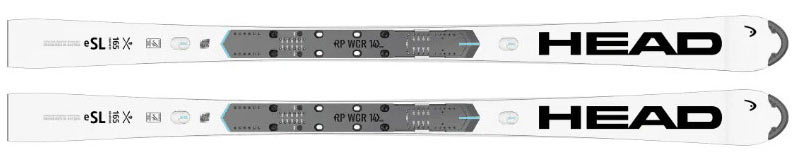

CAN I USE A LONGER GS SKI FOR SUPER G?
The simple answer is “yes.” In masters racing you can use a GS ski for super G as long as it is considered a safe by the race jury, but…
Many new super G racers gravitate to men’s GS skis that are 188cm-195cm with a 30m-35m radius. While the length and radius sound perfect, remember that you are on a GS ski, which is designed for speeds up to 45 miles per hour. Masters super G’s typically hit speeds in the 50’s and sometimes in the 60’s. Super G skis feel a lot more stable because they are made to handle those speeds.
What’s more, those GS skis are likely beefy (stiff) because they are designed for an elite racer who’s very strong and who comes into the front of the ski at the top of each turn with force, allowing the racer to juice the apex of the turn. Super G turns are more drawn out and super G skis are generally softer so they can hug the terrain better.
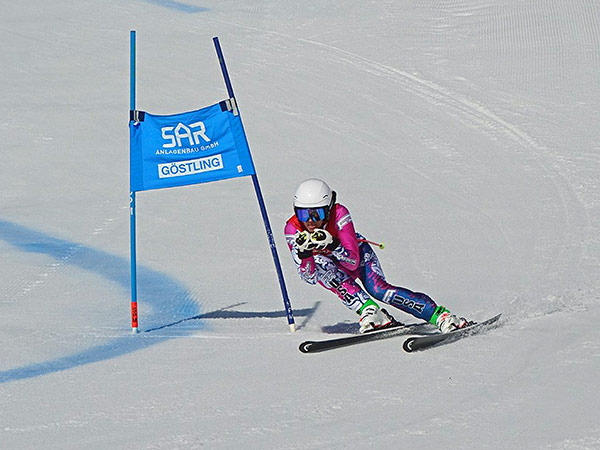
I’ve always favored super G skis over GS skis for super G. GS skis will get you down the course, but super G skis are the right tool for the task.
SKI FLEX
As importantly, the flex of a ski matters. A ski needs to bend in the arc of a turn. If it’s too stiff for your size, strength, and technique, it doesn’t matter what the dimensions of the ski are. That’s why a 185cm ski might turn easier than a 180cm ski, or a 27m-radius ski might be more forgiving than a 25-meter ski. Two pairs of skis from the same manufacturer that are the same model and size might ski very differently if one pair is soft and the other is stiff. When it doubt, go for the softer flexing ski.
DOWNHILL SKIS
Though there is no downhill in international (FIS) masters racing, masters can race downhill in the United States. You can run a downhill on your super G skis, but my suggestion is pick a ski that’s at least 10cm longer and that’s constructed for super G or downhill. The softer the ski, the better.
Got questions or something to add?