

TUCKING–HOW AND WHEN: May 25, 2026.
Go faster (not slower) by tucking the right way and at the right time.
Whenever you drop into a tuck, it feels faster, but are you really going faster? It depends on whether your skis are tracking cleanly. A skidded tuck is not faster than a normal stance over carving skis, especially if you’re able to bend your skis and accelerate from the rebound. This blog will explain how to tuck for maximum speed and aerodynamics, and tactically when to tuck.
HOW TO TUCK
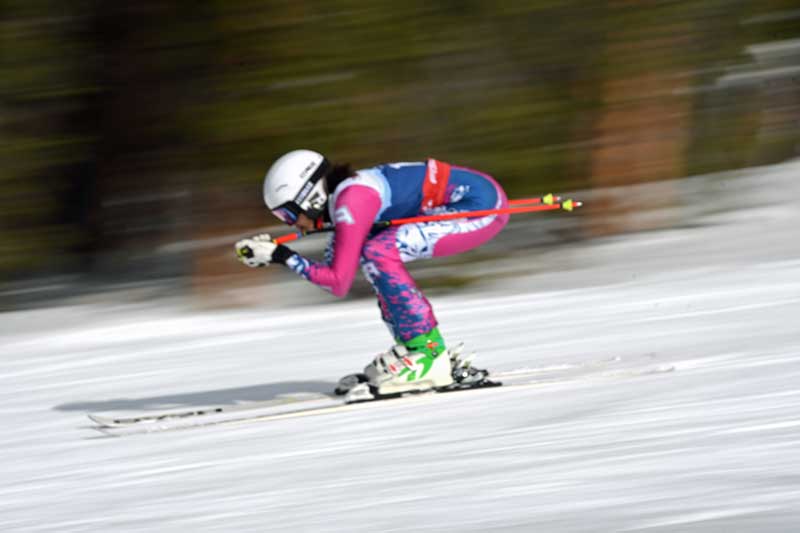
The basics of a low tuck include knees under your armpits, chest down, back slightly curved toward the sky, and your hands up and forward. In essence, you are trying to create an airplane wing with your body, sending air over your back, rather than catching it with your chest.
Your hands should be together in front of your face. They can move fore and aft, and they should stay together.
Your ski poles should be tucked under your armpits, along your sides and hips. They should point back, not to the side, and they should not be higher than your hips, sticking up the air.
Your weight should be forward, with your ankles flexed and your shins solidly against the tongues of your ski boots.
If the speed and other forces on a course are such that you can’t quite hold a low tuck in a shallow turn, stay as low as you can, perhaps opening your outside arm for balance and better weight over the outside ski, while keeping the inside arm in the tuck position.
If opening one arm isn’t enough, don’t throw open both arms, like a hunched over gorilla. You’ll skid your turns, and you won’t be aerodynamic any more. While your chest may be low, your arms catch the wind like anchors dragging on either side of your body. You’ll end up with your weight equally distributed on both feet, leaning into the hill, which will cause your skis to skid. Instead, stand up enough to ski well, then grab your tuck again when you can.
TUCK TURNS
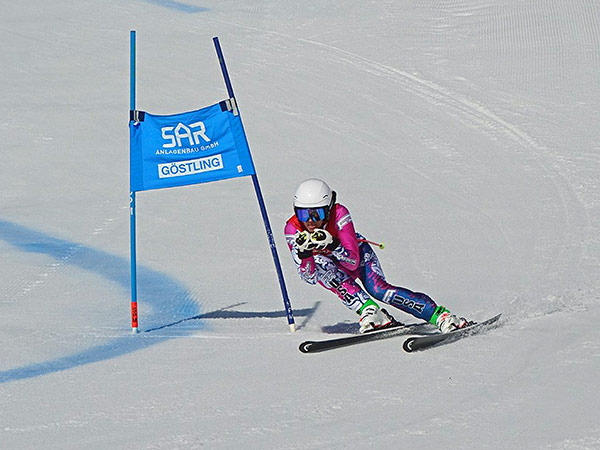
Tuck turns–turning while in a tuck–are an important skill in ski racing. They can be fast if done correctly, but slow if they aren’t.
To turn in a tuck, you need to raise up enough using your legs while staying in a tuck position with your upper body to allow your skis to roll on edge. Like a normal turn, your feet need to get out from under your body, then pass under your torso as they transition to the other side for the next tuck turn.
In a low tuck on a straightaway, your weight is evenly distributed on both skis, but in a tuck turn (like any turn), your weight transfers from outside ski to outside ski.
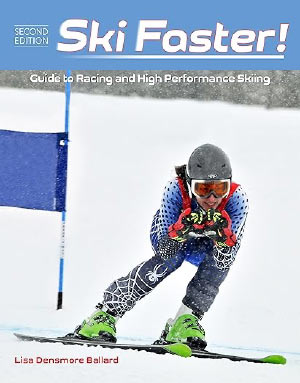
As your skis start to turn, your hands align with the ski tip of your outside (downhill) ski, helping to concentrate weight on the outside ski as your knees and ankles roll into the hill.
Also like a normal turn, be sure to keep your inside hip high, rather than dropped.
If it’s flat, you can create speed by “pumping,” i.e., pressing into the front of your ski boots as you pressure the outside (downhill) ski, causing the ski to bend in the turn then release in the transition, springing you forward a little. If you pump in a tuck turn, be sure to do it only with the legs and feet, not the upper body.
WHEN TO TUCK
Don’t tuck in slalom! Period.
Beyond slalom, an important ski racing caveat is “a clean, carved turn from an upright position is always faster than a skidded tuck turn.” That said, I approach tucking in giant slalom (GS) differently than in super G (SG) and downhill (DH).
In GS, if a section of a course is straight, a tuck works well. Tactically, if you are in a tuck in GS, be hyper aware of how your skis are tracking. At the slightest hint of a skid, break your tuck and make good turns. Often, when I’m inspecting a GS, other racers will ask me if I plan to tuck in a section of the course. Unless it’s obviously straight, it’s hard to tell. Tucking in a GS is often unplanned, except perhaps the last one to three gates above the finish if they are set fairly straight. Often, I grab a tuck in GS because it feels right at that moment.
My attitude in SG and DH is different. Whereas in GS, it’s more “tuck now because I feel like I can,” in SG and DH, I try to tuck as much as possible. That said, at the hint of a skid, I break my tuck and make a clean turn. I also break my tuck as I approach a big direction or terrain change, anticipating the need to stand powerfully on the outside ski.
In this video of Dominik Paris (ITA) winning the SG at the 2026 World Cup Finals in Kvitfjell, Norway, notice how he fights for his tuck and wants to be in it as much as possible, but he breaks it smoothly and decisively when he reaches turny parts of the course. Also notice how he seems to flow down the slope, trying to let his skis run in the fall-line as much as possible.
WHEN TO AVOID TUCKING
Regardless of the ski racing discipline–GS, SG, DH–don’t tuck if you need to make a real turn. A tuck is only used if a section of a course is totally straight, almost straight, or if there’s a lot of distance between gates.
Also, don’t tuck if the course conditions are rough. That said, what’s too rough to tuck for one racer might not be for another. Ski selection and physical fitness are factors. Some skis absorb rough conditions (vibration) better than others. It helps to have the right skis for the type of racing you plan to do. In other words, while you are allowed to use GS skis in a masters SG, SG skis tend to give you a smoother ride. And the stronger you are, the better you can handle an uneven snow surface in a tuck.
10 COMMON MISTAKES RELATED TO TUCKING
- Dropping your hands. Many racers, when they go from a low tuck to a high tuck, leave their hands in the low position, effectively creating a wind-catch with their body between their hands and their head. Keep your hands in front of your face as you get higher or lower in your tuck. That way, the air is directed over your head and back, rather than into your body. You can tell if your hands are too low because you can feel a lot of wind against your face.
- Steering with your hands. In a tuck turn, it’s easy to allow your hands to point in the direction you are going, but that rotates your torso into the turn, causing you to lean into the turn and the tails of your skis to skid. Remember to move your hands toward your outside (downhill) ski tip. In other words, if you are turning to the right, your hands should be slightly to the left, and vice versa.
- Dropping the inside hip. You can have too much of a good thing! If your hands are too far to the outside, your opposite (inside) hip will drop, pulling weight onto your inside ski and likely resulting in skidding. Worse, it puts your knees in a weak position, which can lead to injury if you unexpectedly get jarred by a bump or rut in the track.
- Straightening your line. When you drop into a tuck, there’s a tendency to straighten your line. In ski racing, another caveat is “straight is late.” Do not allow your tuck to dictate your line. The line dictates whether you should tuck.
- Weighting your heels. Be aware of your weight and thus your balance over your skis in a tuck. If you don’t keep your hips up and your chest down, you’ll likely be neutral or on your heels. In ski racing, you always want to be forward with pressure against the tongues of your boots, with pressure and ankle flex increasing throughout each turn. That goes for tucking, too.
The first part of this video shows me dropping into a tuck on the flats during a 2025 FIS Masters Cup GS in Pila, Italy. It’s in slow motion, so you can see how my skis subtly work to generate speed as I make tuck turns. The second part shows me tucking down the last pitch into the finish during the 2026 Masters World Championship GS in Reiteralm, Austria. Part of course inspection is planning how to finish fast and whether you can do it in a tuck, which is often the case.
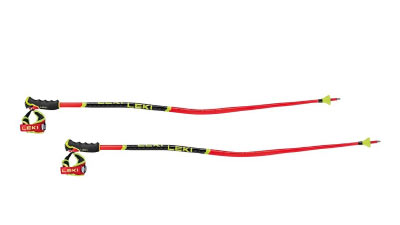
LEKI GS ski poles have some bend to accommodate tucking, but not as much bend as ski poles made specifically for SG/DH, when you tuck much more than in GS. You can use these GS poles comfortably for SG, too.
- Tucking too “deep” into a turn. Another example of too much of a good thing! As you approach a turny section of a course or a knoll, where the course goes from flat to steep and gets more offset, break your tuck a moment sooner than you think, to ensure you are ready to move forward and make clean turns. It’s easy to stay in a tuck until things start to go badly. Then you’re recovering rather than making time in that spot.
- Over-pumping. Pumping in a tuck turn feels good, but it requires touch for the snow surface. If you are too aggressive, your skis sink into the snow rather than moving forward. You might still feel them bend and give energy back, but it’s not helping you go faster. And be sure your pump is forward, not up.
- Thinking you’re tucking, but you’re really not. Have someone video you in a tuck. You might be surprised how high you are when you feel like you’re low. To tuck well, you need to be flexible, particularly in your hips and back.
- Elbow wings. Another common mistake is tucking with the elbows out to the sides, like wings, even though your hands are in front of your face. “Elbow wings” create drag and are not aerodynamic. Keep your elbows over your knees or perhaps slightly inside them if you have wide hips.
- Fighting the fall line. As your speed picks up, you need to stand more strongly and press more assertively forward on your skis, but don’t fight the fall line. Let your skis flow down the hill, and move smoothly in and out of your tuck as you need to. You’ll be faster.
DO I REALLY NEED BENT SKI POLES?
A big reason to use bent ski poles for GS, SG, and DH, is because those poles wrap around your body as you tuck. Straight-shaft poles are awkward in a tuck.
In super G and downhill, the answer is “yes,” use bent poles, because you should be tucking a much as possible.
In GS, the answer is “maybe.” Some racers like bent poles in GS for those occasions when they do tuck, and they can’t tell the difference the rest of the time. Others prefer straight poles because they feel bent poles flex too much when pushing out of the start, and they can get by when they might drop into a tuck. It’s a personal preference.
Got questions or more to add?